Back to toolkit home
Pathway One

Getting screened, understood.

A clear explanation of what your prostate is, what a PSA test measures, why early detection matters, and exactly what happens at a HEALCARE screening event.

01 · The Organ

What is a prostate?

The prostate is a small gland about the size of a walnut. It sits just below the bladder, in front of the rectum. The tube that carries urine out of the body — the urethra — runs right through the middle of it.

Its main job is to help make the fluid in semen. Because of where it sits, problems with the prostate often show up first in how you pee: a weaker stream, trouble getting started, or getting up more often at night.

The prostate keeps growing throughout a man’s life. By age 50, most men have some enlargement. This is normal. But it also makes prostate cancer more common with age — and harder to spot without specific tests.
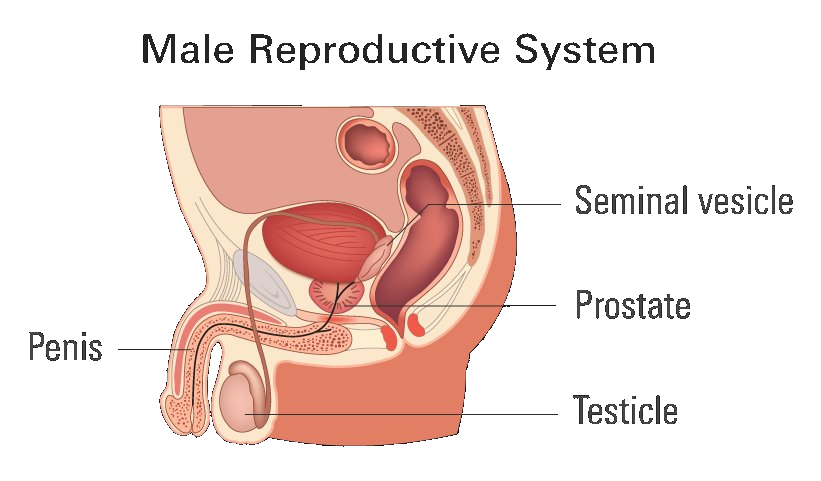
Diagram of the male reproductive system showing the bladder, prostate, seminal vesicle, testicle, and penis.
The male reproductive system · Image: Marley Drug
02 · The Test

What is a PSA test?

PSA stands for Prostate-Specific Antigen. It’s a protein your prostate makes. A small amount of it leaks into your blood. The PSA test is a simple blood draw — the same kind you’d get for any other lab work.

A higher PSA number can be a warning sign. But a high PSA does not always mean cancer. Other things can raise it too: an enlarged prostate (very common with age), an infection, recent sex, or even a hard bike ride.

That’s why one PSA result is not a diagnosis. It’s the start of a conversation. Your doctor will look at the number along with your age, your family history, and how you’ve been feeling.

Ages 40–49
Less than 2.5 ng/mL
A higher number is worth talking through with your doctor — especially for Black men, or men whose father or brother had prostate cancer.
Ages 50–69
Less than 3.5–4.5 ng/mL
The normal range goes up slowly with age. Above the range for your age, your doctor will likely want more tests.
Any age
10.0 ng/mL or above
This is high no matter your age. Get to a urologist soon — don’t wait for a regular checkup.
03 · The Stakes

Why early matters.

Most early prostate cancer has no warning signs at all. By the time you feel pain or have trouble peeing, the cancer has often already spread. Screening finds it while it’s small, still in the prostate, and easier to treat.

~100%
Caught while still in the prostate
When prostate cancer is found while it’s still inside the prostate, about 100 out of 100 men are alive 5 years later. Early detection changes the whole picture.
~32%
Caught after it has spread
Once prostate cancer spreads to other parts of the body, only about 32 out of 100 men are alive 5 years later. The gap between these two numbers is exactly why we screen.
A Note for Black Men

Black men in Georgia are 2.3 times more likely to die from prostate cancer. We also tend to get it younger, and the cancer tends to grow faster. That’s why the American Cancer Society and the Prostate Cancer Foundation both say Black men should start the screening talk at age 40 — ten years earlier than other men.

04 · The Process

What happens at a screening event?

Walk in, get screened, walk out. No insurance needed. No hospital. About 30 minutes from start to finish.

i.
Check in
No insurance needed. Bring a photo ID if you have one. About 5 minutes.
ii.
A few questions
A staff member asks about your family history and how you’ve been peeing. About 10 minutes.
iii.
Talk it through
Your provider explains what the test can and can’t tell you. You decide together. 5–10 minutes.
iv.
Blood draw
A small sample of blood from your arm. Quick and nearly painless. About 5 minutes.
v.
Results
If your number is high, our team calls you and helps line up the next step. 1–5 business days.
Important

Most early prostate cancer has no warning signs at all. That’s the whole reason for screening — especially for Black men, who often get it earlier and have a more aggressive form.

05 · Upcoming Events

Screening dates & times.

We post new screening events as soon as dates are set. To get on our reminder list or hear about an event near you, give us a call.

TBD
Event dates coming soon.

We’re lining up locations in Augusta and Thomson for the next program cycle. Events are usually held at churches, the Wellstar MCG Mobile Health Unit, and other community spots.

Call (706) 721-4526
Continue

Where to next?

II.
My PSA came back elevated.

What the workup is, what each test does, and the names and numbers of the team that will walk you through it.

What happens now
III.
I want to eat better for my health.

Food as medicine, the food swamp problem, and the HEALCARE nutrition program — plant-based recipes built on Southern soul food.

Show me the food